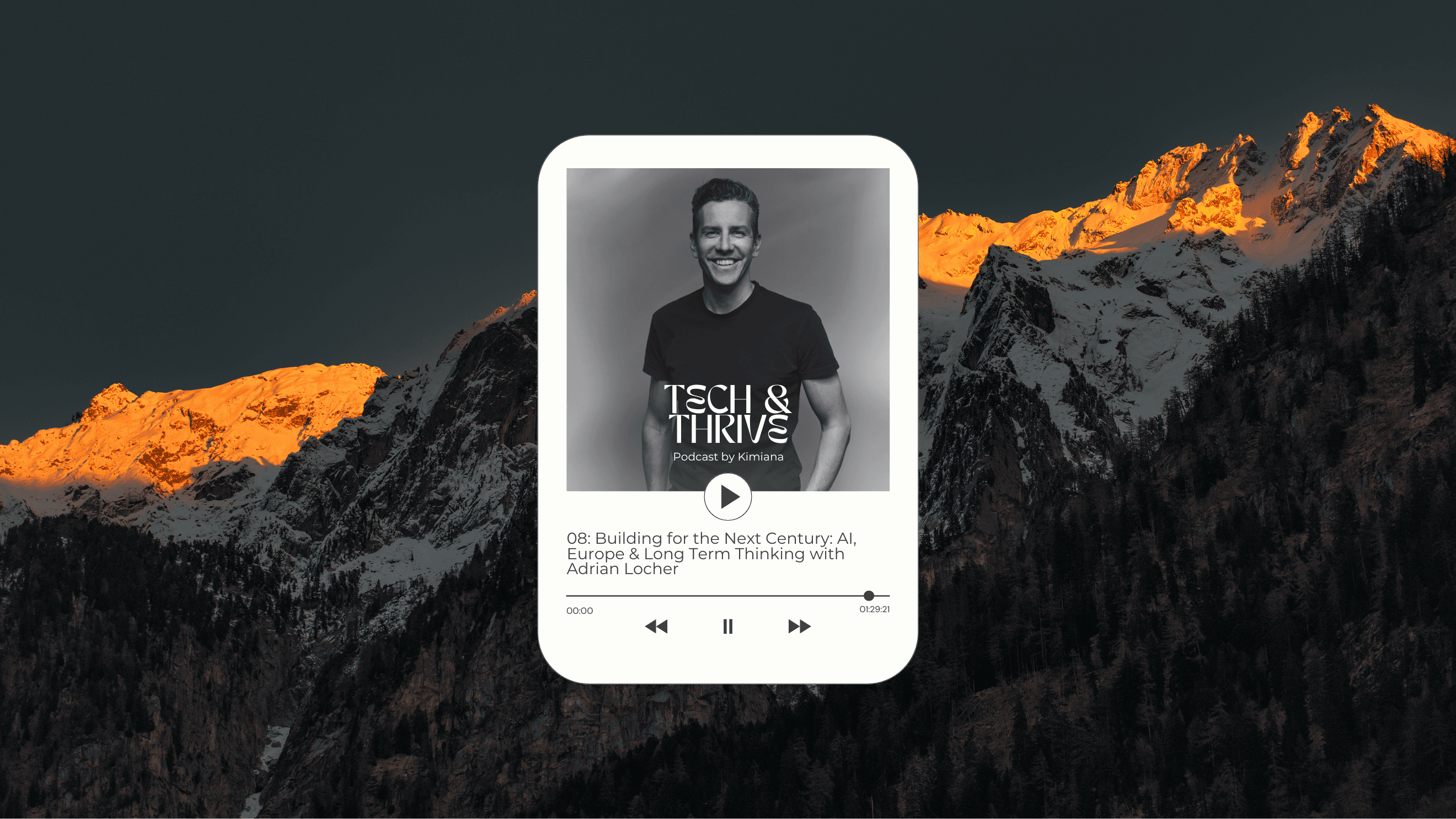
Building for the Next Century: A Conversation with Adrian Locher
Building for the Next Century: A Conversation with Adrian Locher
Building for the Next Century: A Conversation with Adrian Locher
A conversation with Merantix co-founder Adrian Locher on building AI first companies, why Europe keeps holding itself back, and the discipline of failing forward.
A conversation with Merantix co-founder Adrian Locher on building AI first companies, why Europe keeps holding itself back, and the discipline of failing forward.
Two decades of building
Adrian Locher describes himself as a builder before anything else. He started by building cars with his father, then computers, then websites, then companies. The progression is not incidental. Every phase of his career has followed the same instinct: take things apart, understand how they work, build something new.
His first real venture was a software company founded during his time at HSG St. Gallen. It led, eventually, to DeinDeal, the Swiss e-commerce platform he co-founded in 2010 and grew to over 100 million Swiss francs in revenue before its acquisition by Ringier. After the exit, Adrian gave himself a sabbatical with one rule: no business decisions allowed. He aimed for twelve months and made it to about ten before starting his next chapter.
That pause is what led to Merantix.
The Silicon Valley pivot
The sabbatical took him to San Francisco, where AI was beginning to dominate the conversation in ways it had not yet reached Switzerland. Adrian got obsessed, attended machine learning courses at Stanford, and concluded something that would shape the next decade of his work.
"I thought and I still think this is going to be the defining technology of the century, not of the decade, but of the century."
In 2016 he co-founded Merantix in Berlin with Rasmus, whom he had met through a chance conversation with a stranger on a plane. Today the platform is a hybrid AI venture studio and investment fund, with an AI campus in Berlin hosting 1,500 machine learning professionals, a sister hub in London, a professional services arm and a portfolio spanning diagnostics, cybersecurity, materials discovery and industrial AI.
Building teams that hold under pressure
Across two decades and more than ten companies, Adrian has developed a clear philosophy on hiring and team building. Domain expertise matters, but it is not the variable that decides whether something works.
"Where I think you should not have any diversity is when it comes to values."
His personal test is simple. Would he go on vacation with this person? Would he enjoy it? If the answer is no, the working relationship is not going to hold. The discipline is in being honest about that answer, especially under hiring pressure.
When Adrian and Rasmus decided to consider working together, they applied the same principle. They spent six to eight months in what Adrian calls founder dating, collaborating on projects without committing, drafting a written prenup covering the scenarios where things might not work, and only then formalising the partnership.
"You want to have had stressful situations with your co-founder and see how people react and learn about their behavior in the more unconscious moments."
Intuition as a strategic tool
One of the more interesting threads in the conversation was Adrian's defence of intuition. He sees it not as the opposite of rational decision making but as a complement to it, and possibly the more powerful of the two.
"The rational part of your brain is actually the small data part. What people call the gut feel is actually the big data part that tells you a lot, even without realizing why it tells you something is off."
For Adrian, intuition is not mysticism. It is pattern recognition built up over years of exposure, processed faster than conscious thought can articulate. The discipline is learning to trust it without ignoring the data, and to use both in combination rather than in opposition.
His broader principle on decisions: "Making a decision is, after all, always better than not making one."
What makes an AI company defensible
Adrian's investment thesis at Merantix is shaped by a deliberately provocative starting point: assume technology will become commoditised. Assume AI will come out of the wall, cheaply, in five years.
What then makes a company defensible?
For Adrian, the answer is rarely the technology itself. It is the business model underneath, the lock in effects, the integration into customer workflows. He uses the example of Cambrium, a Merantix portfolio company in Berlin building bio materials using machine learning and protein engineering. What makes Cambrium defensible is not the AI behind their protein folding work, although that is impressive. It is that the materials they produce are sometimes two, five, or a thousand times stronger than what is currently available.
"Our core assumption and investment thesis is always the company needs to be defensible and need to have a mode, even if that frontier technology at some point starts to commoditize."
Why Europe holds itself back
The conversation turned, inevitably, to Europe. Adrian's view is direct. The talent is here. The institutions are world class. The capital exists, at least at the early stage. What is missing is courage.
"Us not being courageous enough, us not being willing to make mistakes, us lying to ourselves that things will go smooth and no bad things will happen. That just puts us in a very dangerous position."
He argues that European institutions have been built around the assumption that things will stay the same. That assumption was always wrong, but in a moment of rapid technological transformation it becomes actively dangerous. Wealth is preserved through innovation, not through managing the status quo.
His view on regulation follows the same logic: regulate applications, not the underlying technology. Double down on the verticals where Europe is already strong, particularly healthcare, advanced manufacturing and regulated industries.
Failing forward
Adrian talks openly about failure, which is rarer among founders at his stage than it should be. He does not romanticise it.
"It feels shit. And that's okay. I am not going to glorify failing, because it still feels shit."
What he has learned over twenty years is not that failure is fine. It is that the response to failure is the only part of the equation that is fully under his control. Things happen. Markets move. Decisions turn out to be wrong in hindsight. The only consistent variable is how you react.
He told the story of an early MP3 player business he ran during university, where the team had calculated the unit economics wrongly and was losing money on every sale without realising it for months. By the time they noticed, the company had to be shut down. Expensive lesson, real cost, useful learning.
Staying grounded
For someone running a venture platform with multiple initiatives, a portfolio of companies and a family with young children, the question of how to stay grounded is not trivial.
Adrian's framing is direct. Three buckets: family and friends, business, and self. The self bucket is the one he used to neglect. He now treats it as the foundation rather than the afterthought.
"I am my own resource before I can be a resource to others."
He compares founders to athletes. There are three phases: training, competition and recovery. Every good athlete knows that skipping any of them is a guarantee of underperformance. The third one is the one most founders try to skip.
The advice
Adrian has heard the question many times, and his answer has not changed.
"Just do it. Whatever you feel like you want to build, just do it. No matter whether it fails or not, it's going to help you figure out the way much faster than if you don't do it."
The second part of the advice is harder. Figure yourself out first. Understand what you are passionate about, what you are good at, what you are willing to do the work for. Without that, excellence is unreachable. With it, almost anything is possible.
Where to follow Adrian
You can follow Adrian Locher on LinkedIn or learn more about Merantix at merantix.com and merantixcapital.com.
Two decades of building
Adrian Locher describes himself as a builder before anything else. He started by building cars with his father, then computers, then websites, then companies. The progression is not incidental. Every phase of his career has followed the same instinct: take things apart, understand how they work, build something new.
His first real venture was a software company founded during his time at HSG St. Gallen. It led, eventually, to DeinDeal, the Swiss e-commerce platform he co-founded in 2010 and grew to over 100 million Swiss francs in revenue before its acquisition by Ringier. After the exit, Adrian gave himself a sabbatical with one rule: no business decisions allowed. He aimed for twelve months and made it to about ten before starting his next chapter.
That pause is what led to Merantix.
The Silicon Valley pivot
The sabbatical took him to San Francisco, where AI was beginning to dominate the conversation in ways it had not yet reached Switzerland. Adrian got obsessed, attended machine learning courses at Stanford, and concluded something that would shape the next decade of his work.
"I thought and I still think this is going to be the defining technology of the century, not of the decade, but of the century."
In 2016 he co-founded Merantix in Berlin with Rasmus, whom he had met through a chance conversation with a stranger on a plane. Today the platform is a hybrid AI venture studio and investment fund, with an AI campus in Berlin hosting 1,500 machine learning professionals, a sister hub in London, a professional services arm and a portfolio spanning diagnostics, cybersecurity, materials discovery and industrial AI.
Building teams that hold under pressure
Across two decades and more than ten companies, Adrian has developed a clear philosophy on hiring and team building. Domain expertise matters, but it is not the variable that decides whether something works.
"Where I think you should not have any diversity is when it comes to values."
His personal test is simple. Would he go on vacation with this person? Would he enjoy it? If the answer is no, the working relationship is not going to hold. The discipline is in being honest about that answer, especially under hiring pressure.
When Adrian and Rasmus decided to consider working together, they applied the same principle. They spent six to eight months in what Adrian calls founder dating, collaborating on projects without committing, drafting a written prenup covering the scenarios where things might not work, and only then formalising the partnership.
"You want to have had stressful situations with your co-founder and see how people react and learn about their behavior in the more unconscious moments."
Intuition as a strategic tool
One of the more interesting threads in the conversation was Adrian's defence of intuition. He sees it not as the opposite of rational decision making but as a complement to it, and possibly the more powerful of the two.
"The rational part of your brain is actually the small data part. What people call the gut feel is actually the big data part that tells you a lot, even without realizing why it tells you something is off."
For Adrian, intuition is not mysticism. It is pattern recognition built up over years of exposure, processed faster than conscious thought can articulate. The discipline is learning to trust it without ignoring the data, and to use both in combination rather than in opposition.
His broader principle on decisions: "Making a decision is, after all, always better than not making one."
What makes an AI company defensible
Adrian's investment thesis at Merantix is shaped by a deliberately provocative starting point: assume technology will become commoditised. Assume AI will come out of the wall, cheaply, in five years.
What then makes a company defensible?
For Adrian, the answer is rarely the technology itself. It is the business model underneath, the lock in effects, the integration into customer workflows. He uses the example of Cambrium, a Merantix portfolio company in Berlin building bio materials using machine learning and protein engineering. What makes Cambrium defensible is not the AI behind their protein folding work, although that is impressive. It is that the materials they produce are sometimes two, five, or a thousand times stronger than what is currently available.
"Our core assumption and investment thesis is always the company needs to be defensible and need to have a mode, even if that frontier technology at some point starts to commoditize."
Why Europe holds itself back
The conversation turned, inevitably, to Europe. Adrian's view is direct. The talent is here. The institutions are world class. The capital exists, at least at the early stage. What is missing is courage.
"Us not being courageous enough, us not being willing to make mistakes, us lying to ourselves that things will go smooth and no bad things will happen. That just puts us in a very dangerous position."
He argues that European institutions have been built around the assumption that things will stay the same. That assumption was always wrong, but in a moment of rapid technological transformation it becomes actively dangerous. Wealth is preserved through innovation, not through managing the status quo.
His view on regulation follows the same logic: regulate applications, not the underlying technology. Double down on the verticals where Europe is already strong, particularly healthcare, advanced manufacturing and regulated industries.
Failing forward
Adrian talks openly about failure, which is rarer among founders at his stage than it should be. He does not romanticise it.
"It feels shit. And that's okay. I am not going to glorify failing, because it still feels shit."
What he has learned over twenty years is not that failure is fine. It is that the response to failure is the only part of the equation that is fully under his control. Things happen. Markets move. Decisions turn out to be wrong in hindsight. The only consistent variable is how you react.
He told the story of an early MP3 player business he ran during university, where the team had calculated the unit economics wrongly and was losing money on every sale without realising it for months. By the time they noticed, the company had to be shut down. Expensive lesson, real cost, useful learning.
Staying grounded
For someone running a venture platform with multiple initiatives, a portfolio of companies and a family with young children, the question of how to stay grounded is not trivial.
Adrian's framing is direct. Three buckets: family and friends, business, and self. The self bucket is the one he used to neglect. He now treats it as the foundation rather than the afterthought.
"I am my own resource before I can be a resource to others."
He compares founders to athletes. There are three phases: training, competition and recovery. Every good athlete knows that skipping any of them is a guarantee of underperformance. The third one is the one most founders try to skip.
The advice
Adrian has heard the question many times, and his answer has not changed.
"Just do it. Whatever you feel like you want to build, just do it. No matter whether it fails or not, it's going to help you figure out the way much faster than if you don't do it."
The second part of the advice is harder. Figure yourself out first. Understand what you are passionate about, what you are good at, what you are willing to do the work for. Without that, excellence is unreachable. With it, almost anything is possible.
Where to follow Adrian
You can follow Adrian Locher on LinkedIn or learn more about Merantix at merantix.com and merantixcapital.com.
Two decades of building
Adrian Locher describes himself as a builder before anything else. He started by building cars with his father, then computers, then websites, then companies. The progression is not incidental. Every phase of his career has followed the same instinct: take things apart, understand how they work, build something new.
His first real venture was a software company founded during his time at HSG St. Gallen. It led, eventually, to DeinDeal, the Swiss e-commerce platform he co-founded in 2010 and grew to over 100 million Swiss francs in revenue before its acquisition by Ringier. After the exit, Adrian gave himself a sabbatical with one rule: no business decisions allowed. He aimed for twelve months and made it to about ten before starting his next chapter.
That pause is what led to Merantix.
The Silicon Valley pivot
The sabbatical took him to San Francisco, where AI was beginning to dominate the conversation in ways it had not yet reached Switzerland. Adrian got obsessed, attended machine learning courses at Stanford, and concluded something that would shape the next decade of his work.
"I thought and I still think this is going to be the defining technology of the century, not of the decade, but of the century."
In 2016 he co-founded Merantix in Berlin with Rasmus, whom he had met through a chance conversation with a stranger on a plane. Today the platform is a hybrid AI venture studio and investment fund, with an AI campus in Berlin hosting 1,500 machine learning professionals, a sister hub in London, a professional services arm and a portfolio spanning diagnostics, cybersecurity, materials discovery and industrial AI.
Building teams that hold under pressure
Across two decades and more than ten companies, Adrian has developed a clear philosophy on hiring and team building. Domain expertise matters, but it is not the variable that decides whether something works.
"Where I think you should not have any diversity is when it comes to values."
His personal test is simple. Would he go on vacation with this person? Would he enjoy it? If the answer is no, the working relationship is not going to hold. The discipline is in being honest about that answer, especially under hiring pressure.
When Adrian and Rasmus decided to consider working together, they applied the same principle. They spent six to eight months in what Adrian calls founder dating, collaborating on projects without committing, drafting a written prenup covering the scenarios where things might not work, and only then formalising the partnership.
"You want to have had stressful situations with your co-founder and see how people react and learn about their behavior in the more unconscious moments."
Intuition as a strategic tool
One of the more interesting threads in the conversation was Adrian's defence of intuition. He sees it not as the opposite of rational decision making but as a complement to it, and possibly the more powerful of the two.
"The rational part of your brain is actually the small data part. What people call the gut feel is actually the big data part that tells you a lot, even without realizing why it tells you something is off."
For Adrian, intuition is not mysticism. It is pattern recognition built up over years of exposure, processed faster than conscious thought can articulate. The discipline is learning to trust it without ignoring the data, and to use both in combination rather than in opposition.
His broader principle on decisions: "Making a decision is, after all, always better than not making one."
What makes an AI company defensible
Adrian's investment thesis at Merantix is shaped by a deliberately provocative starting point: assume technology will become commoditised. Assume AI will come out of the wall, cheaply, in five years.
What then makes a company defensible?
For Adrian, the answer is rarely the technology itself. It is the business model underneath, the lock in effects, the integration into customer workflows. He uses the example of Cambrium, a Merantix portfolio company in Berlin building bio materials using machine learning and protein engineering. What makes Cambrium defensible is not the AI behind their protein folding work, although that is impressive. It is that the materials they produce are sometimes two, five, or a thousand times stronger than what is currently available.
"Our core assumption and investment thesis is always the company needs to be defensible and need to have a mode, even if that frontier technology at some point starts to commoditize."
Why Europe holds itself back
The conversation turned, inevitably, to Europe. Adrian's view is direct. The talent is here. The institutions are world class. The capital exists, at least at the early stage. What is missing is courage.
"Us not being courageous enough, us not being willing to make mistakes, us lying to ourselves that things will go smooth and no bad things will happen. That just puts us in a very dangerous position."
He argues that European institutions have been built around the assumption that things will stay the same. That assumption was always wrong, but in a moment of rapid technological transformation it becomes actively dangerous. Wealth is preserved through innovation, not through managing the status quo.
His view on regulation follows the same logic: regulate applications, not the underlying technology. Double down on the verticals where Europe is already strong, particularly healthcare, advanced manufacturing and regulated industries.
Failing forward
Adrian talks openly about failure, which is rarer among founders at his stage than it should be. He does not romanticise it.
"It feels shit. And that's okay. I am not going to glorify failing, because it still feels shit."
What he has learned over twenty years is not that failure is fine. It is that the response to failure is the only part of the equation that is fully under his control. Things happen. Markets move. Decisions turn out to be wrong in hindsight. The only consistent variable is how you react.
He told the story of an early MP3 player business he ran during university, where the team had calculated the unit economics wrongly and was losing money on every sale without realising it for months. By the time they noticed, the company had to be shut down. Expensive lesson, real cost, useful learning.
Staying grounded
For someone running a venture platform with multiple initiatives, a portfolio of companies and a family with young children, the question of how to stay grounded is not trivial.
Adrian's framing is direct. Three buckets: family and friends, business, and self. The self bucket is the one he used to neglect. He now treats it as the foundation rather than the afterthought.
"I am my own resource before I can be a resource to others."
He compares founders to athletes. There are three phases: training, competition and recovery. Every good athlete knows that skipping any of them is a guarantee of underperformance. The third one is the one most founders try to skip.
The advice
Adrian has heard the question many times, and his answer has not changed.
"Just do it. Whatever you feel like you want to build, just do it. No matter whether it fails or not, it's going to help you figure out the way much faster than if you don't do it."
The second part of the advice is harder. Figure yourself out first. Understand what you are passionate about, what you are good at, what you are willing to do the work for. Without that, excellence is unreachable. With it, almost anything is possible.
Where to follow Adrian
You can follow Adrian Locher on LinkedIn or learn more about Merantix at merantix.com and merantixcapital.com.
Whereveryouareinyourtechnologyjourney,ashortconversationcanclarifythenextstep.
Whereveryouareinyourtechnologyjourney,ashortconversationcanclarifythenextstep.

Whereveryouareinyourtechnologyjourney,ashortconversationcanclarifythenextstep.